





By Alice Dickerson | Founder, Division 08 Marketing
6–7 minute read • February 6, 2026
How Advertising Shapes Buyer Behavior
Advertising does more than communicate product features or announce availability. In the building product industry, advertising plays a far more influential role: it shapes how buyers perceive brands, how they recall options, and how they ultimately make decisions. When used intentionally, advertising functions as a behavioral cue—an environmental signal that guides attention and influences action over time.
This concept is especially important in an industry defined by long sales cycles, multiple decision-makers, and high-stakes specifications. Visibility is not simply about awareness; it is about remaining present in the buyer’s mental landscape from early design through final procurement. Brands that understand how advertising functions as a behavioral cue are better positioned to build recognition, reduce decision-making friction, and influence demand.
Why Cues Matter in Buyer Behavior
Behavioral science shows that most decisions do not begin with evaluation. They begin with recognition. James Clear’s work on habit formation explains that every behavior starts with a cue—something that captures attention and prompts a response. In marketing, advertising serves that same function. It reminds buyers that a solution exists, reinforces familiarity, and brings a brand to mind at the moment it matters.
BJ Fogg’s Behavior Model further reinforces this idea, noting that behavior occurs when motivation, ability, and a prompt align. Advertising supplies the prompt. Without it, even motivated buyers may fail to act simply because the brand does not come to mind.
In the building product industry, this dynamic is amplified. Architects, designers, contractors, specification writers, and facility managers juggle dozens of projects at once. Their attention is divided, their timelines extended, and their memories stretched. Consistent cues help ensure a brand remains recognizable and relevant across that complexity.
Recognition Requires Reinforcement
Even manufacturers with strong brand equity continue to advertise consistently. This is not because they lack recognition; recognition fades without reinforcement. Visibility must be renewed, especially in a market where buyers are exposed to constant new information and competing solutions.
Repetition strengthens memory. Over time, consistent exposure builds familiarity, and familiarity reduces perceived risk. When a buyer recognizes a brand quickly, they are more likely to trust it, consider it, and ultimately specify it. This is not persuasion in the traditional sense—it is cognitive efficiency. Buyers choose what feels known.
The Habit Loop and Brand Memory
Charles Duhigg’s habit loop—cue, routine, reward—helps explain how advertising influences long-term behavior. In a marketing context:
The cue is repeated brand exposure
The routine is brand recall or consideration
The reward is reduced effort, confidence, or perceived reliability
Brands that maintain consistent visual and verbal cues—colors, language, design patterns, value propositions—make it easier for buyers to recall them later. Over time, this recall becomes automatic.
This matters in specification-driven industries. Buyers are not starting from scratch with each decision; they rely on mental shortcuts built through prior exposure. Advertising helps establish and maintain those shortcuts.
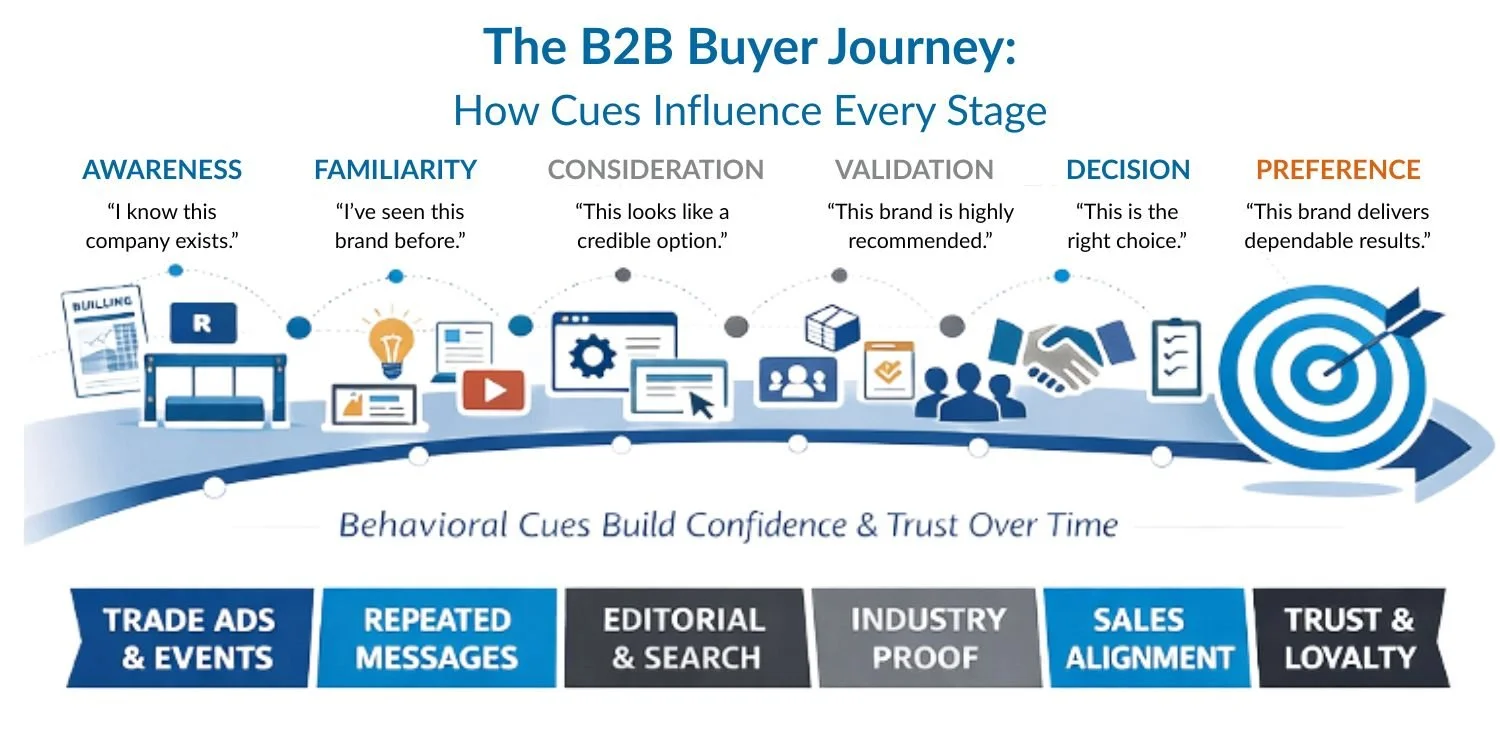
The B2B Buyer Journey
Environment Shapes Decisions
Clear also emphasizes that environment shapes behavior more than motivation. In the building product industry, the buyer’s environment includes trade publications, digital platforms, professional networks, events, email communications, and social channels. Advertising helps shape that environment by placing consistent cues where buyers already spend their time.
Common environments where cues reinforce behavior include:
Trade magazines and industry websites
Digital advertising and retargeting
LinkedIn and professional social platforms
Industry events and conferences
Email newsletters and educational content
Each appearance reinforces recognition. Over time, these cues reduce the cognitive effort required to choose a product or supplier.
Because purchasing decisions involve multiple audiences—direct buyers and influencers alike—visibility must occur across more than one channel. When advertising is removed, manufacturers must compensate with increased sales outreach, more frequent visits, or higher reliance on one-to-one engagement. While valuable, those approaches rarely scale as efficiently as strategic advertising.
Clarity Creates Cognitive Shortcuts
Clear messaging strengthens the effectiveness of behavioral cues. Donald Miller’s StoryBrand framework emphasizes that buyers gravitate toward brands that communicate simply and predictably. Advertising reinforces that clarity by repeating the same core message across multiple touchpoints.
When buyers consistently encounter a clear value proposition, they process it faster and with less friction. This cognitive ease increases confidence and accelerates decision-making—particularly important in industries where justification and accountability are required.
Advertising and Editorial Visibility
Advertising also plays an indirect but important role in editorial visibility. Publishers and editors naturally think of the brands they see most often. When developing articles, trend features, or expert roundups, they are more likely to reach out to companies that are visible within their publication ecosystem.
This is not transactional and not guaranteed—but it is practical. Familiarity guides awareness. Brands that are not advertising or participating in industry platforms may simply fall out of view, making them less likely to be considered for editorial opportunities.
This dynamic becomes more pronounced when publications are affiliated with trade associations or industry events. Media coverage often aligns with participation and visibility. Brands that are present tend to remain part of the conversation.
Why This Matters for Authority and SEO
Editorial visibility contributes to long-term authority in ways advertising alone cannot. Independent, third-party coverage supports credibility, search engine optimization, and discoverability across AI-driven search platforms.
Wikipedia, in particular, relies on independent editorial sources to establish notability. Advertising and sponsored content do not qualify. Manufacturers without consistent editorial mentions are unlikely to meet these criteria, limiting their long-term digital authority. Advertising supports editorial visibility by keeping brands present and recognizable to publishers.
Reducing Risk Through Visibility
Strong brands reduce perceived risk. In building products—where performance, safety, and longevity matter—buyers are more comfortable specifying solutions from manufacturers that appear stable, active, and engaged in the industry.
Consistent advertising signals:
Ongoing market presence
Operational stability
Industry participation
Long-term commitment
These signals matter, especially when decisions carry professional responsibility.
Strategic Considerations for Building Product Manufacturers
For building product manufacturers and other construction-related suppliers, advertising should be viewed as a strategic tool for maintaining visibility across the audiences that influence and execute purchasing decisions. This includes trade professionals who purchase products and the architects and designers whose specifications shape demand. Consistent presence in the publications and platforms these audiences trust reinforces familiarity, credibility, and long-term preference.
As with any marketing investment, advertising decisions are most effective when approached strategically. Researching the right publications, understanding audience reach, and aligning media choices with business objectives helps ensure advertising supports recognition, reduces risk, and strengthens brand presence throughout the buying journey.
Frequently Asked Questions
What are behavioral cues in advertising?
Behavioral cues are repeated signals that influence recognition and recall. In advertising, these cues help buyers remember brands and make decisions more confidently over time.
How does advertising influence buyer decisions in B2B markets?
Advertising increases mental availability, making brands easier to recall when decisions are made. This is especially important in long, complex B2B buying cycles.
Why do well-known building product manufacturers continue advertising?
Because familiarity fades without reinforcement. Consistent advertising helps prevent brands from becoming “out of sight, out of mind.”
How does advertising support specification-driven buying?
Advertising reinforces recognition among architects, designers, and specifiers, making it easier to justify product selection during specification reviews.
Is advertising still effective in long sales cycles?
Yes. In long sales cycles, advertising maintains visibility across multiple decision stages and stakeholders until purchasing decisions occur.
What is the difference between advertising and editorial coverage?
Advertising supports visibility and recall. Editorial coverage builds authority and credibility. Both work together to strengthen long-term influence.
How does advertising affect editorial visibility?
Brands that maintain visibility are more likely to be remembered by publishers and editors when developing articles or seeking expert input.
What happens if a manufacturer stops advertising?
Reduced visibility can lead to lower recall, increased reliance on sales outreach, and a greater risk of being overlooked during decision-making.
References
Clear, James. Atomic Habits.
Fogg, BJ. The Fogg Behavior Model.
Stanford Behavior Design Lab. Fogg Behavior Model resources.
Duhigg, Charles. The Power of Habit.
Miller, Donald. StoryBrand.
Division 08 Marketing works with building product manufacturers to evaluate media options, plan strategic advertising programs, and align creative with long-term market objectives.
